

Your Enterprise Security Strategy Must Evolve With Your Business
Strategic security is not a project—it’s a business continuity foundation.
Enterprise cybersecurity solutions represent a fundamental shift from reactive security measures to strategic, risk-driven protection architectures. Unlike tactical cybersecurity packages, enterprise solutions integrate network security, endpoint protection, cloud security, and compliance alignment into a unified operational framework. Organizations with distributed infrastructure, multiple business units, and complex regulatory requirements require security strategies that address risk across all attack vectors simultaneously—not piecemeal tools applied after breaches occur.
The challenge enterprises face is not identifying threats; it is architecting resilience across systems that evolve faster than security controls can adapt. When you partner with experienced enterprise cybersecurity services providers, you gain access to strategic frameworks that embed risk assessment into IT planning and align security investments with business continuity objectives.
Key Takeaways
- → Enterprise cybersecurity integrates multiple layers—cloud protection, endpoint monitoring, compliance frameworks—into unified architecture, not disconnected tools
- → Risk assessment frameworks (NIST, ISO 27001) structure identification of exposure and investment prioritization
- → Strategic architecture treats cloud, hybrid, and endpoint detection as interconnected elements, not separate technologies
- → Security aligned to business strategy reduces breach costs, improves SLA compliance, and strengthens resilience
- → Compliance (HIPAA, PCI-DSS, SOC 2) is embedded in solutions, not added as afterthought
- → Implementation requires phased onboarding, clear escalation, and executive reporting linking security metrics to business impact
What Enterprise Cybersecurity Solutions Include
Enterprise cybersecurity solutions operate as integrated operational systems, not collections of isolated tools. This distinction is critical.
A comprehensive enterprise cybersecurity solution encompasses:
Network Security & Infrastructure Protection
Enterprise environments operate across multiple network segments, hybrid cloud deployments, and edge computing environments. Enterprise solutions provide centralized monitoring and threat response across this distributed infrastructure, with enforcement of security policies regardless of where workloads run. This means your on-premises systems, cloud infrastructure, and edge devices all operate under unified visibility and control.
Endpoint Detection & Response (EDR)
Enterprise organizations cannot rely on antivirus definitions updated hourly. Endpoint detection systems provide continuous behavioral analysis, threat hunting, and automated response capabilities across thousands of devices. This includes employee laptops, servers, IoT devices in manufacturing environments, and specialized equipment in healthcare settings. When threats emerge, your security team detects them in hours rather than weeks.
Cloud Security & Data Protection
When infrastructure migrates to AWS, Azure, or Google Cloud, traditional firewall-based security breaks. Enterprise solutions provide cloud-native security controls, data classification, and encryption standards that protect cloud workloads without impeding business agility. As organizations expand their cloud backup and disaster recovery capabilities, security must evolve alongside infrastructure.
Security Monitoring & Incident Response
Enterprise organizations require 24/7 threat monitoring with defined escalation paths, incident playbooks, and executive reporting. This includes threat intelligence integration, forensic investigation capabilities, and communication protocols for breach scenarios. Your security operations team operates with clear SLAs and documented procedures for every incident type.
Compliance & Audit Framework
Enterprise solutions embed compliance controls into operational processes. Rather than conducting annual audits to prove compliance, enterprise security architectures maintain continuous compliance monitoring, evidence collection, and reporting for HIPAA, PCI-DSS, SOC 2, and other regulatory standards. Compliance becomes a property of sound security operations rather than a separate audit effort.
Risk Assessment & Strategic Planning
Enterprise cybersecurity begins with structured risk assessment—identifying exposure in cloud environments, supply chain dependencies, third-party integrations, and emerging threat vectors. This assessment informs strategic roadmapping and investment prioritization.
Why Enterprise Organizations Need Strategic Security Architecture
Generic cybersecurity packages fail for enterprise organizations because they assume uniform environments and static threat landscapes.
Enterprises operate under different assumptions:
Regulatory Complexity
A healthcare system must satisfy HIPAA requirements across 50+ hospitals and clinics. A financial services firm operates under PCI-DSS, GDPR, and state-level privacy laws simultaneously. These compliance obligations intertwine with security architecture—they are not parallel concerns. Strategic security solutions integrate compliance controls into operational processes, making regulatory readiness a byproduct of sound security hygiene rather than an expensive compliance project.
Distributed Attack Surface
Enterprise environments include on-premises servers, cloud workloads, SaaS applications, mobile endpoints, and third-party integrations. Each represents a potential entry point for sophisticated adversaries. Unified visibility across this distributed environment is impossible with disconnected point solutions. Strategic architecture treats the entire environment as one operational plane.
According to NIST Cybersecurity Framework guidance, organizations must approach security as an integrated function that spans all systems and business processes. This principle is especially critical for enterprises managing complex technology ecosystems.
Business Continuity Imperative
When a mid-market company experiences a 12-hour outage, revenue drops. When a Fortune 500 organization experiences a 12-hour outage, supply chains break, clients lose confidence, and the organization faces regulatory scrutiny. Enterprise cybersecurity solutions are engineered around business continuity—security decisions prioritize resilience and recovery speed, not just threat prevention.
Sophisticated Threat Intelligence
Commodity attackers use known exploits and phishing templates. Sophisticated adversaries targeting enterprises deploy zero-day exploits, establish persistent access, and exfiltrate data over months. Enterprise solutions integrate threat intelligence feeds, behavioral analysis, and forensic investigation to detect and respond to advanced persistent threats before strategic damage occurs.
The Cost of Enterprise Security Gaps
Enterprises facing inadequate security architecture experience compounding risks that extend far beyond individual incidents.
Breach Impact & Recovery
According to the IBM Cost of a Data Breach Report, the average cost of a data breach globally exceeds $4 million, with costs varying significantly by industry. For large enterprises, breach costs often exceed 10 million dollars when factoring in notification costs, regulatory fines, forensic investigation, reputation damage, and business interruption.
What matters most: detection and containment time significantly affects breach cost. The Verizon Data Breach Investigations Report consistently demonstrates that organizations detecting breaches in weeks rather than months reduce downstream costs by millions of dollars.
Regulatory Penalties & Compliance Failure
Organizations that experience breaches while lacking adequate security controls face regulatory fines measured in tens of millions. A healthcare organization failing HIPAA obligations may face 100 million dollar penalties plus breach notification costs. Enterprises without documented, verifiable security frameworks assume regulatory exposure they may not recognize until after breach investigation.
Business Continuity & Revenue Impact
Enterprise downtime costs vary dramatically by industry. Financial services lose approximately 5,600 dollars per minute during outages, healthcare loses roughly 10,000 dollars per minute, and manufacturing loses around 20,000 dollars per minute. Security incidents causing system unavailability translate directly to revenue loss and customer attrition.
Talent & Operational Drain
Organizations without mature security architectures require security teams to respond reactively to incidents, patch systems manually, and investigate threats inefficiently. This operational burden prevents strategic security work and leads to talent burnout and expensive hiring cycles.

Enterprise Security Layers Comparison
| Security Layer | Ad-Hoc Approach | Strategic Architecture |
| Network Security | Firewall rules updated manually when breaches occur | Centralized policy enforcement with continuous threat monitoring across all network segments |
| Endpoint Protection | Antivirus with weekly definitions | Continuous behavioral analysis, threat hunting, and automated response across 1000+ devices |
| Cloud Security | Misconfigured cloud accounts with minimal visibility | Cloud-native controls, data classification, encryption enforcement, and compliance monitoring |
| Threat Response | Manual investigation taking weeks to identify breach scope | 24/7 monitoring with automated playbooks enabling response within hours |
| Compliance | Annual audit proving controls existed at audit time | Continuous compliance monitoring with automated evidence collection and reporting |
| Executive Visibility | Security leaders lack clear metrics connecting security to business impact | Real-time dashboards showing risk metrics, incident trends, and strategic recommendations |
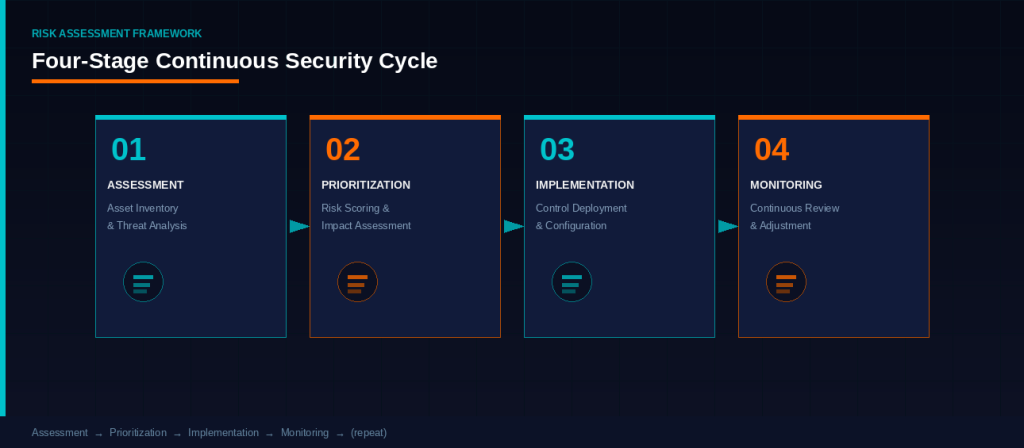
How to Build an Effective Enterprise Cybersecurity Strategy
Strategic cybersecurity architecture follows a structured methodology rather than reactive implementation.
Phase 1: Comprehensive Risk Assessment
Begin with candid assessment of exposure across networks, cloud environments, endpoints, and third-party integrations. This assessment should identify:
- → Critical assets and business-critical systems
- → Current threat exposure and vulnerabilities
- → Compliance gaps relative to regulatory requirements
- → Third-party risk dependencies
- → Infrastructure vulnerabilities in on-premises and cloud environments
Assessment outputs should quantify risk in business terms—not just threat severity, but potential revenue impact and operational disruption. Risk assessment forms the foundation of strategic security planning, as emphasized by leading industry frameworks and standards.
Phase 2: Strategic Roadmap Definition
Assessment findings inform a multi-year security roadmap. Rather than chasing every threat, roadmaps prioritize investments based on:
- → Business impact of potential breaches
- → Regulatory compliance requirements
- → Current capability maturity
- → Staffing and resource constraints
- → Technology modernization timelines
This roadmap sequence investments logically—foundational controls first, advanced capabilities layered after foundational security operations mature.
Phase 3: Implementation & Operational Alignment
When you work with experienced managed IT services partners, security implementation integrates with IT operations rather than operating parallel to it. This requires:
- → Clear escalation paths and incident response playbooks
- → Security tool integration into existing monitoring and ticketing systems
- → Training and change management for affected teams
- → Defined SLAs for security operations (mean time to detect, mean time to respond)
- → Executive reporting connecting security metrics to business continuity objectives
Phase 4: Continuous Monitoring & Strategic Improvement
Strategic security is not a project with an endpoint. Continuous monitoring includes:
- → Threat intelligence feeds and vulnerability scanning
- → Security metrics dashboards tracking detection, response, and remediation
- → Regular risk assessment updates as business and threat landscape evolve
- → Quarterly executive reviews connecting security investments to risk reduction
- → Penetration testing and security assessments validating control effectiveness

Strategic Planning Framework vs Ad-Hoc Response
| Dimension | Ad-Hoc / Reactive | Strategic / Proactive |
| Decision Timeline | Decisions made during or after incidents | Investments planned 12-24 months in advance based on risk assessment |
| Budget Allocation | Spending driven by emergency response needs | Budget reflects strategic priorities with flexibility for emerging threats |
| Tool Selection | Tools chosen to fix immediate problems | Tools selected for integration, scalability, and long-term operational efficiency |
| Team Skill Development | Security teams reactive; no training budget | Training and career development aligned to strategic roadmap |
| Executive Communication | Security reports focus on incident counts | Executive dashboards show risk reduction and business continuity impact |
| Compliance Posture | Compliance discovered during audits | Compliance continuously monitored with automated evidence collection |
Enterprise Compliance & Regulatory Requirements
Enterprise organizations operate under strict compliance requirements. Rather than viewing compliance as a separate project, strategic cybersecurity solutions embed compliance controls into operational processes.
HIPAA (Healthcare)
Healthcare organizations storing protected health information must implement access controls, encryption, audit logging, and breach notification procedures. Enterprise security solutions provide these controls automatically—HIPAA compliance becomes a property of sound operational security, not a bolted-on requirement.
PCI-DSS (Payment Processing)
Organizations processing credit card payments must maintain network segmentation, encryption, and access controls. According to PCI Security Standards Council, enterprise solutions enforce these controls across all systems processing payment data, with continuous compliance validation rather than annual validation.
SOC 2 (Service Organizations)
Service providers must demonstrate controls over availability, security, and confidentiality. Enterprise solutions provide continuous evidence collection and reporting—SOC 2 audits become validation exercises rather than stressful scrambles to prove historical compliance.
ISO 27001 (Information Security Management)
Organizations seeking ISO 27001 certification must document security processes, risk assessment procedures, and control implementation. Enterprise solutions provide these documentation frameworks automatically, reducing the administrative burden of certification.
Addressing Enterprise Security Concerns
Enterprise organizations often have legitimate questions about security strategy. Rather than viewing security as a vendor selection exercise, consider these as strategic business questions that deserve thoughtful answers.
Question: “We already have an IT team. Why would we need external security expertise?”
Your internal IT team provides critical infrastructure management and operational support. However, strategic cybersecurity requires specialized expertise in threat landscape analysis, compliance frameworks, and enterprise architecture design—functions that are distinct from infrastructure operations.
Many organizations benefit from a hybrid model where internal IT teams maintain infrastructure continuity while external security advisors provide specialized expertise and fresh perspective on risk. Think of it as the difference between a company’s accounting department (internal operations) and external auditors (specialized verification and strategy). Both are necessary for different reasons.
Security advisory partnerships work best when they complement rather than replace internal capabilities. The goal is to enhance your existing team’s capacity while bringing in expertise that’s expensive to develop internally.
Question: “We haven’t experienced a breach, so our risk profile must be manageable.”
The absence of detected breaches does not indicate the absence of threats or vulnerabilities. Over 40% of cyberattacks target small and mid-sized businesses, but sophisticated adversaries actively target enterprises with persistent, multi-month campaigns designed to avoid detection.
According to research from CISA (Cybersecurity Infrastructure Security Agency), many enterprise breaches remain undetected for months or years. Some are only discovered through forensic investigation triggered by unusual activity. Others surface months later when stolen data appears in criminal marketplaces or regulatory notifications.
Proactive risk assessment identifies exposure before breaches occur—not as a reactive response to incidents. The organizations most resilient to breach impact are those that assume threats exist and architect defenses accordingly.
Question: “Enterprise cybersecurity consulting and implementation is expensive. Shouldn’t our current security spending be sufficient?”
Security investment should scale with business risk exposure, not with historical spending patterns. Consider the math:
- → Average enterprise data breach: $4+ million (direct costs + fines + business interruption)
- → Enterprise downtime cost: $5,600-20,000+ per minute depending on industry
- → Regulatory penalties for inadequate controls: $10-100+ million
Strategic security investments that prevent or reduce breach impact typically pay for themselves many times over. A comprehensive risk assessment often identifies gaps that are inexpensive to remediate early but catastrophic to fix after breach discovery.
View security investment in context of potential risk exposure rather than in isolation. A $200,000 annual security investment is negligible compared to the cost of a single significant breach.
Question: “Our current security tools and vendors handle our needs. Do we really need a strategic overhaul?”
Mature enterprises often accumulate security tools across multiple years and vendors—a firewall from one provider, endpoint protection from another, cloud security from a third party, compliance tools from a fourth. This layered approach creates visibility gaps and operational complexity that slows incident response.
When security tools don’t integrate well, security teams spend time manually correlating alerts from different systems, increasing mean time to detect threats. Fragmented approaches also make it difficult to enforce consistent security policies across all systems and environments.
Strategic architecture integrates tools into unified frameworks that improve visibility and reduce response time. This doesn’t necessarily mean replacing all existing tools—it means connecting them into a coordinated system where data flows between platforms and teams can respond faster to threats.
Integration Considerations
As you evaluate your security posture, consider these strategic integration points:
Risk Assessment Foundation Begin with candid assessment of exposure. Not all risks are equal. Prioritize based on business impact rather than attempting to address every threat simultaneously.
Operational Integration Security improvements work best when they integrate with existing IT operations rather than operating parallel to them. This requires clear escalation paths, defined SLAs, and executive reporting that connects security metrics to business outcomes.
Compliance as Operational Property Rather than treating compliance as a separate audit exercise, embed compliance requirements into operational processes. This makes regulatory readiness a natural outcome of sound security practices.
Team Capability Building Security maturity requires capability development. Effective partnerships include knowledge transfer and training that help your internal team build expertise over time.
Conclusion: Strategic Security as Business Continuity
Enterprise cybersecurity solutions are not luxury add-ons or compliance checkbox exercises. They are business continuity foundations that protect revenue, enable growth, and strengthen competitive advantage.
Organizations that approach security as a strategic discipline—not a technical function—outperform those treating security reactively. When security leadership sits at the executive table and participates in business planning, security investments align with business objectives. When compliance frameworks integrate into operational processes, regulatory readiness becomes automatic rather than stressful.
The enterprises most resilient to breach impact, regulatory scrutiny, and operational disruption are those that embed risk assessment into strategic planning, adopt unified security architectures, and measure success not in incident counts but in business continuity metrics.
Your enterprise security strategy should evolve as your business evolves. It should address not just today’s threats but tomorrow’s threat landscape. It should enable business agility while protecting critical assets. It should make your organization stronger, not slower.
The question is not whether to invest in enterprise cybersecurity solutions. The question is how quickly you can architect the integrated security framework your business requires.
When you’re ready to evaluate your security posture against enterprise-grade standards, Cool Technology Group provides comprehensive risk assessment, strategic roadmapping, and implementation guidance. We help enterprises build security architectures that enable business growth while reducing risk to acceptable levels.
Speak with our IT experts to discuss your enterprise security strategy and determine where your organization stands relative to enterprise-grade security benchmarks.

Common Questions About Enterprise Security
Do you conduct comprehensive risk assessments?
Yes. Enterprise risk assessments map current state across networks, cloud environments, endpoints, and third-party integrations, then identify gaps relative to industry frameworks (NIST, ISO 27001) and your specific regulatory requirements.
How do you approach compliance alignment?
We embed compliance requirements into security architecture rather than treating compliance as a separate project. This ensures continuous compliance validation and reduces the administrative burden of compliance audits.
Do you support hybrid cloud and multi-cloud environments?
Yes. Modern enterprises operate across on-premises infrastructure, private cloud, and multiple public cloud providers. Our solutions provide unified visibility and control across these distributed environments.
What does your onboarding process look like for enterprise implementations?
Assessment → Strategic Roadmap → Phased Implementation → Operational Integration → Continuous Improvement. Each phase includes executive reporting, clear milestones, and validation against security metrics.
How do you measure security effectiveness and risk reduction?
We track quantifiable metrics: detection times, incident response times, vulnerability remediation cycles, compliance validation status, and business continuity impact. These metrics connect security improvements to business outcomes.
Can you integrate with our existing tools and monitoring systems?
Yes. We work with your existing infrastructure rather than requiring replacement. Integration with PSA/RMM systems, SIEM platforms, and incident response workflows ensures security improvements operate within your existing operational framework.
READ MORE SECTION
- → Managed IT Security: How Managed IT Security Protects Modern Businesses
- → Cloud Security Services: Protecting Your Cloud Infrastructure
- → Information Security Consulting Services: Strengthening Your Security Framework
- → Cybersecurity Consulting Services: When Does Your Business Need One?