
- Written by: Anthony Herrera
- February 11, 2026
Why a Managed IT provider with built-in security Is the Best Choice for Small Businesses
You didn’t wake up planning to deal with security today. But something happened.
Maybe your team’s computers slowed to a crawl, costing you three hours of lost productivity. Maybe someone opened a suspicious email, and now you’re wondering what got accessed. Or maybe your biggest client asked a simple question: “How do you protect our data?” and you realized you didn’t have a clean answer.
That moment forces a decision. You’ve moved from “we’ll handle IT eventually” to “we need to handle it now.” The problem is you probably don’t have an IT person on staff. You definitely don’t have a security expert.
Most small business owners think they need to hire both. They don’t. What you need is a security-focused managed service provider (MSP). Someone who handles your day-to-day IT operations while treating security as core to everything they do, not as an optional add-on. That’s the foundation that actually protects your business.
So what actually happens next?
The Real Cost of Ignoring Security Basics
We work with Texas-based businesses all the time. What we consistently see is this: most small business security incidents have nothing to do with sophisticated hackers or advanced attack techniques. They stem from operational gaps that were preventable all along.
Consider what typically happens. An employee’s device goes unpatched for months, making it vulnerable to known exploits anyone could leverage. Access permissions sit unchanged after someone leaves the team, which means a former contractor still has login credentials to your financial systems. A backup gets configured once, tested never; when you actually need it, you discover it doesn’t work. Your network runs without monitoring, so when a breach occurs, it goes undetected for weeks while damage accumulates.
None of this requires technical sophistication. These are basic oversights. The problem is they compound over time, and they’re completely preventable.
The financial impact of ignoring this reality is staggering. According to IBM, the Cost of a Data Breach report puts the average data breach at $4.88 million. For most small businesses, a single breach of that magnitude is existential. You’re looking at operational shutdowns lasting days or longer. Revenue stops. Incident response teams cost thousands. Customer trust evaporates. Your reputation suffers real, lasting damage. Insurance rates spike.
But here’s what separates businesses that survive breaches from those that don’t: response speed. Organizations running proactive security measures cut their mean time to respond by 28% compared to reactive approaches. That 28% difference translates directly into smaller breach impact, contained damage, and significantly lower costs.
Reactive response means exponentially higher expenses. Proactive security means you catch threats early, contain them fast, and minimize the fallout.
The owners who act on these gaps before they become incidents are the ones who sleep at night knowing their business is actually protected. The ones who wait learn this lesson the hard way.
Why Your Current IT Support Isn’t Protecting You
You might have someone handling IT already. Resets passwords, fixes email, troubleshoots devices. That person is valuable. But here’s the critical problem: they’re only fixing things after they break.
When someone just responds to IT problems, you’re paying for firefighting, not prevention. A problem happens, you call, they fix it. Temporary solution. The same problem pops up again because the root cause never got addressed. You’re trapped in a cycle of repeated issues, mounting downtime, and growing security risks.
The cost of downtime isn’t abstract. When your systems go down, revenue stops immediately. According to The Network Installers, small businesses lose between $137 and $427 per minute in labor costs and recovery expenses; if you’re running mission-critical servers, that number jumps to $1,667 per minute. That means a two-hour outage could cost $20,000 to $200,000 depending on your operation.
For context, midsize businesses face $14,000 to $14,056 per minute in unplanned downtime costs, while large enterprises lose $23,750 per minute (roughly $1.4 million per hour). Your business might not operate at that scale, but the principle holds: every minute your systems are down is money walking out the door.
Real managed IT services operate completely differently. Instead of waiting for problems to happen, someone is actively watching your network for threats and performance issues. Instead of fixing the same problem repeatedly, they’re preventing it from happening in the first place. They’re asking:
- → Why does this keep happening?
- → Are patches being applied?
- → Is access configured correctly?
- → Are outdated systems creating vulnerabilities?
This shift from fixing problems after they happen to stopping them before they start is what actually protects a small business. Your IT environment isn’t just being maintained when something breaks. It’s being actively managed so downtime gets prevented entirely, and when issues do occur, they get resolved before significant damage happens.
Five Areas Where Your Business Is Vulnerable Right Now
When you implement proper IT management, security isn’t bolted on as an afterthought. It’s built into how systems operate. Here’s what actually gets protected:
Devices and Endpoints. Every computer, laptop, and phone gets locked down with encryption, firewalls, and anti-malware. Screen locks get enforced. Weak passwords get replaced with standards. Outdated software either gets patched or replaced. Your devices become hardened against attack rather than vulnerable entry points.
Access and Permissions. When someone joins your team, their access gets configured correctly from day one. They get exactly what they need for their role, nothing more. When their role changes, permissions get reviewed and adjusted. When they leave, access gets revoked immediately. This single practice eliminates one of the most common ways breaches happen.
Data Protection and Backups. Backups get set up, monitored, and tested regularly. Not set and forget. Not hoping they work. Actually verified before disaster strikes. You know your data can be restored because it’s been tested. If something’s broken, you find out now and fix it.
Network Activity and Threats. Continuous monitoring watches for unusual activity. Suspicious connections. Unauthorized access attempts. Malware movement. Data exfiltration. Early detection means early containment, which means minimal impact.
Vulnerability Management. Security patches get applied on a strict schedule. Not deferred. Not “we’ll get to it eventually.” Updates get tracked and verified. Old, unpatched software—one of the easiest ways attackers get in—never becomes a vulnerability in your environment.
The outcome: most small business security incidents get prevented entirely. The ones that do happen get caught so early they’re manageable. Your team stays productive. Your operations stay stable. Your customers’ data stays safe.
How Managed IT Services Eliminate Security Gaps Before They Become Breaches
Most small businesses in Texas get stuck in one of two places. Either they have reactive IT support (someone fixing tickets as they come in) or they have nothing at all, hoping nothing breaks.
When you implement managed IT services, the shift matters enormously. Instead of firefighting, you’re preventing. Instead of surprises, you have predictability. Instead of hoping you’re secure, you know you’re secure.
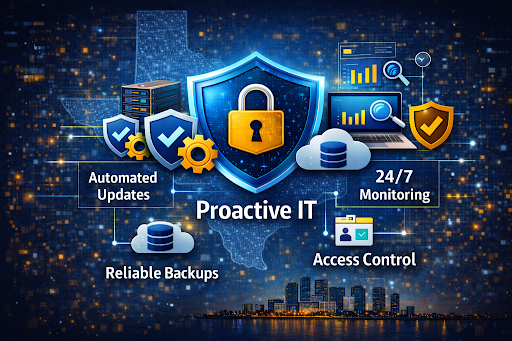
Here’s what changes: your devices stay updated with security patches automatically. Your network gets monitored continuously so issues get caught before your team notices. Your backups work reliably because they’re tested regularly. Your access controls stay current as people join, change roles, or leave. When your team needs help, they have someone to turn to.
For small business owners in Houston without an in-house IT team, this is the turning point. You move from hoping nothing breaks to knowing that someone is actively protecting your operation.
What Gets Done in Your First 30 Days
When you bring in managed IT services, immediate action starts. These aren’t promises of future security. These are concrete steps that protect your business starting now.
Your vulnerable devices get hardened. Every computer, laptop, and phone in use gets scanned and configured with proper security. Weak passwords get replaced with enforced standards. Encryption gets enabled on everything. Firewalls get configured correctly. Outdated software either gets updated or gets replaced. Within days, devices that were potential entry points become locked down.
Your access permissions get audited and corrected. The provider reviews who has access to what. Current employees get exactly what they need for their role, nothing more. Excessive permissions get removed. Unnecessary service accounts get disabled. Former employees who still somehow have access get removed immediately.
Your backups get tested before you need them. The provider doesn’t just trust that old backups work. They test them. They restore a sample to verify the process actually works. If something’s broken, you find out now and fix it now. Not after a disaster.
Your network gets monitored 24/7. Continuous monitoring starts immediately. For the first time, someone is actively watching your network for unusual activity. Suspicious connections. Unauthorized access attempts. All of it gets detected early because someone’s watching.
Your team gets a dedicated support partner. Instead of scrambling to find someone when something breaks, your team has a single point of contact. Issues get logged, tracked, and resolved with accountability.
Within the first month, most business owners notice fewer system problems, faster issue resolution, and genuinely feel secure for the first time.
The Real Impact on Your Bottom Line
Less Downtime. Proactive monitoring catches problems before they impact operations. When issues do happen, resolution is faster because someone’s already assigned to your account.
Better Protection. Basic oversights that cause most incidents get eliminated. Patches stay current. Access stays controlled. Backups actually work. Threats get detected early.
Predictable Costs. No more emergency service calls at premium rates. You know what you’re paying each month. You know what service level you’re getting. You can budget confidently.
Your Team Stays Productive. They’re not waiting for IT help or dealing with slow systems. They can focus on what actually grows your business.
Customer Confidence. When clients ask how you protect their data, you have a real answer. Not vague promises. Specific practices. Actual monitoring. Verifiable security.
How to Identify the Right Provider
Not all providers operate with the same priorities. Some treat security as an optional feature. The right partner treats it as core to everything they do.
Ask these questions:
→ How do you schedule, track, and verify updates across all systems? Do you have an automated process that reports what’s pending?
→ What happens when someone joins, changes roles, or leaves? Is this process the same every time? How do you verify access gets revoked?
→ Are backups actively monitored and tested? How often? Can you show us a recent test result proving they work?
→ How do you prevent recurring problems? Do you look beyond the immediate fix to address root causes?
→ How quickly would you detect unusual activity on our network? Do you have continuous monitoring or do you check logs after problems are reported?
If the conversation centers on tools and software licenses, security is an add-on feature. That’s not what you need. If the conversation centers on processes, prevention, and continuous monitoring, you’ve found someone who understands IT management properly.
The Path Forward: Build on Solid Ground
Most small business owners build over time. You don’t buy everything at once.
Start with managed IT services that treat security as core. This foundation addresses the gaps that cause most incidents. It stabilizes your IT environment, establishes consistent practices, and creates accountability. You move to a place where systems work reliably and security isn’t a question mark anymore.
Here’s what you’ll notice within the first few months:
→ Your team spends less time waiting for IT issues to get resolved. Things just work consistently.
→ You know your backups actually work. You’ve tested them.
→ Critical patches get applied within days, not months.
→ When someone leaves the company, their access gets revoked immediately. No orphaned accounts.
→ You stop dealing with the same problems repeatedly. Issues get fixed and prevented from happening again.
→ You sleep better knowing someone is actively watching your systems, not waiting for damage to happen.
Most importantly, you have a real answer when customers, partners, or your insurance company asks how you protect data. It’s specific. It’s verifiable. It’s real.
Then, as your business grows or requirements change, you layer in additional services if needed. Maybe regulatory compliance becomes important. Maybe you’re handling more sensitive data. At that point, deeper security services make sense. But you’re building on a solid, secure foundation.
What Happens if You Wait
If you ignore these gaps, here’s what typically happens.
A malicious email gets through. Someone clicks it. Suddenly, ransomware is spreading through your network. Your systems lock up. Your data is inaccessible. The attacker demands money. You lose revenue, time, and trust.
Or a former employee still in your systems accesses customer data. You discover it weeks later. Now you’re notifying customers, dealing with regulators, managing the fallout.
Or your backup fails when you need it most. You lose data. You lose business. You lose customers.
Or a critical vulnerability is patched everywhere except your network. You get exploited. You get compromised. You spend months recovering.
These aren’t hypotheticals. These happen to small businesses every week.
The business owner who addressed these gaps early avoids all of this.
The Decision: Invest Now or Pay Later
Running a small business means making trade-offs. You can’t hire a full IT department. You need solutions that work within your reality and your budget.
Managed IT services get you there. They prevent the incidents that would cost you far more. They give you a partner who prevents problems instead of just fixing them. They move you from hoping nothing goes wrong to knowing that risks are being managed continuously.
The alternative is living with basic security gaps in your operation. Knowing devices probably aren’t fully patched. Knowing access might not be properly controlled. Hoping nothing bad happens before you get around to fixing it.
That’s not a sustainable strategy for a growing business.
Start with managed IT services that prioritize protection. Address the gaps now. Build the foundation that allows your business to grow without constant security concerns.
Your business deserves better than reactive firefighting. It deserves a partner who prevents the incidents that would cost you far more than the investment in proper management.
The question isn’t whether you can afford managed IT services. It’s whether you can afford not to have them.
Worried your IT and security gaps are bigger than you think?
Book a quick call and get a clear picture of what’s protected, what’s exposed, and what to fix first.
Frequently Asked Questions
1. What is a security-focused MSP?
A security-focused Managed Service Provider manages day-to-day IT operations while embedding cybersecurity into every layer of support. Instead of treating security as a separate product, it is built into patching, access control, monitoring, backups, and user management.
2. How is managed IT services different from regular IT support?
Traditional IT support reacts after something breaks. Managed IT services are proactive. Systems are monitored continuously, updates are applied on schedule, access is reviewed regularly, and issues are prevented before they disrupt operations or create security risk.
3. Do small businesses really need managed IT services?
Yes. Most small business security incidents come from basic IT gaps, not advanced attacks. Without managed IT services, patching is inconsistent, access is rarely reviewed, backups go untested, and risks quietly build over time.
4. What’s the difference between an MSP and an MSSP?
An MSP focuses on running and maintaining IT operations, such as devices, networks, users, and support. An MSSP focuses only on cybersecurity, offering deeper services like advanced threat monitoring, incident response, and compliance reporting. Many small businesses start with a security-focused MSP and add MSSP services later if needed.
5. Is an MSP enough for cybersecurity?
For most small businesses, yes. A security-focused MSP covers the majority of real-world risks by managing patching, access, backups, endpoint protection, and monitoring. MSSP services typically become necessary when compliance requirements increase or sensitive data exposure grows.
6. How does managed IT services help prevent ransomware?
Ransomware often enters through unpatched systems, weak access controls, or compromised email accounts. Managed IT services reduce this risk by enforcing updates, monitoring unusual activity, securing endpoints, and maintaining reliable backups that can be restored quickly if needed.
7. What happens during the first month of managed IT services?
The first 30 days usually focus on stabilizing risk. Devices are reviewed and secured, access permissions are audited, backups are tested, monitoring is activated, and support processes are put in place. Most businesses notice fewer issues and faster resolution almost immediately.
8. How does managed IT services reduce downtime?
By monitoring systems continuously and addressing issues early, managed IT services prevent many outages before users notice them. When problems do occur, they are resolved faster because the provider already understands the environment and owns the fix.
9. Are managed IT services worth it for small businesses in Texas?
Yes. Texas businesses often operate across multiple locations, field teams, or hybrid environments. Managed IT services help standardize systems, reduce operational risk, and maintain consistent security practices as the business grows.
10. How do I know if an MSP actually prioritizes security?
A security-focused MSP can clearly explain how patching is tracked, how access is managed when employees join or leave, how backups are tested, and how threats are detected early. If the conversation focuses only on tools, security is likely an add-on. If it focuses on process and prevention, security is part of operations.