
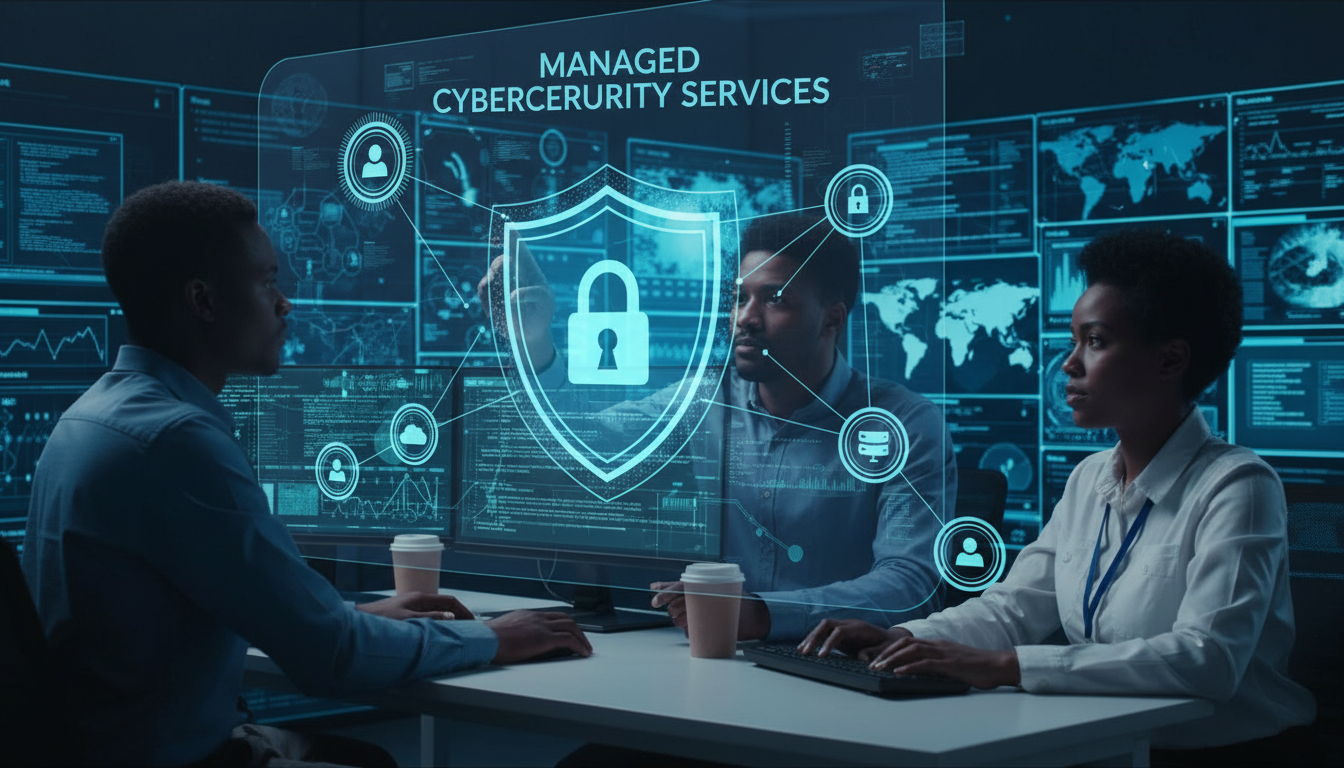
Beyond Traditional IT Support: Why Cybersecurity Requires Specialized Management
Cybersecurity is not IT support—it’s a specialized discipline requiring different expertise, tools, and operational approaches.
Many organizations conflate managed IT services with managed cybersecurity services. Managed IT services maintain system uptime, user support, and infrastructure operations. Managed cybersecurity services focus on threat detection, vulnerability management, incident response, and security optimization. While related, they require different specialization.
Managed cybersecurity emerges as a distinct offering when organizations realize that good IT management alone doesn’t prevent breaches—dedicated security expertise and 24/7 threat monitoring are necessary to detect and respond to sophisticated attacks.
Key Takeaways
- → Managed cybersecurity services provide specialized threat detection, vulnerability management, and incident response that IT teams lack expertise or capacity to perform
- → Organizations can’t build internal security operations cost-effectively—managed services provide 24/7 security expertise at fraction of internal security team cost
- → Threat landscape evolves constantly—managed security providers maintain expertise in emerging threats that organizations can’t develop independently
- → Effective cybersecurity requires both preventing breaches and responding rapidly when prevention fails—managed services address both imperatives
- → Managed security integrates with existing infrastructure rather than replacing IT operations, creating comprehensive security approach
- → Organizations using managed cybersecurity detect breaches weeks faster and suffer 60-70% lower breach costs compared to organizations managing security internally
What Managed Cybersecurity Services Actually Include
Managed cybersecurity encompasses several interconnected protective functions that collectively provide comprehensive threat management.
Threat Detection and Monitoring
Managed security providers deploy detection tools across your infrastructure—servers, endpoints, networks, cloud systems. These tools continuously analyze security events looking for indicators of compromise. Unlike automated scanning, managed security includes human expertise—security analysts review alerts, investigate suspicious activity, and determine whether events represent actual threats or false alarms. According to MarketsandMarkets Cybersecurity Forecast, managed detection and response services represent fastest-growing segment of the cybersecurity market because organizations increasingly recognize professional monitoring catches threats that automated tools and internal teams miss.
This human expertise is critical. Modern threat actors use sophisticated techniques to evade automated detection. Experienced security analysts recognize attack patterns that automated tools miss. This combination of automated monitoring plus human analysis catches threats that either approach alone would miss.
Vulnerability and Threat Intelligence
Managed cybersecurity services maintain databases of known vulnerabilities and threats. When new vulnerabilities are discovered, managed providers immediately assess impact to your environment, prioritize patching, and guide remediation. This rapid response to emerging threats prevents attackers from exploiting vulnerabilities before you patch them. According to research from ENISA (EU Cybersecurity Agency), vulnerability response time is critical—vulnerabilities left unpatched for 30+ days are exploited at rates 3-5x higher than recently patched systems.
Incident Response
When threats are detected, immediate response is critical. Managed cybersecurity services include incident response—trained teams available to investigate incidents, contain threats, remediate compromises, and restore normal operations. This specialized expertise is expensive for most organizations to maintain internally.
Incident response includes forensic investigation (understanding what happened), containment (stopping attacks from spreading), eradication (removing attackers from systems), and recovery (restoring normal operations).
Security Assessments and Testing
Managed cybersecurity providers conduct security assessments—penetration testing (simulated attacks), vulnerability scanning, configuration review, compliance verification. These assessments identify security weaknesses before attackers exploit them, enabling proactive remediation.
24/7 Security Operations
Unlike IT operations that often default to business hours coverage, cybersecurity threats occur 24/7. Managed cybersecurity provides continuous 24/7 monitoring with escalation procedures for critical threats. This continuous coverage detects threats during nights and weekends when internal security teams are unavailable.
Managed Cybersecurity vs. Internal Security Teams
Organizations considering security staffing choices face economic reality: building internal security operations is extremely expensive.
Cost Comparison:
Minimal internal security requires at least one dedicated security professional ($120K-150K annually) plus tools, training, and infrastructure. For 24/7 coverage, you need 3-4 people minimum ($360K-600K annually) plus benefits, tools, and ongoing training. Most organizations can’t afford this investment.
Managed cybersecurity provides similar or superior capability for significantly lower cost—typically $2K-15K monthly depending on organization size and security complexity. This pricing spreads infrastructure and expertise across multiple customers, dramatically reducing per-customer cost.
Expertise Advantage:
Managed security providers employ specialists in different security domains—threat intelligence analysts, incident response experts, vulnerability management specialists, compliance auditors. Each specialist brings deep expertise in their domain developed across multiple customer environments. According to Accenture Cybersecurity Reports, organizations using managed security with specialized experts detect and respond to threats 5-7x faster than organizations relying on generalist internal security teams.
Internal security teams typically become generalists handling all security functions, unable to develop deep expertise in specialized areas. Managed security gives organizations access to specialist expertise they couldn’t afford to hire individually.
Scalability:
Your organization’s security needs change—additional systems, new threat landscapes, regulatory requirements, organizational growth. Managed security scales with your needs. Internal security teams face hiring and training challenges when scaling.
Incident Response Quality:
When breaches occur, rapid professional response minimizes damage. Managed cybersecurity includes experienced incident response teams trained to handle sophisticated attacks. Most organizations lack this capability internally and discover breaches weeks after they occurred.
Security Functions – Managed vs. Internal
| Function | Managed Security | Internal Team | Advantage |
| 24/7 Monitoring | Yes | Difficult to implement | Managed |
| Threat Intelligence | Current, industry-wide | Limited to your org | Managed |
| Incident Response | Specialized experts | Generalist IT staff | Managed |
| Vulnerability Management | Systematic, prioritized | Reactive, sporadic | Managed |
| Tool Management | Included | Requires hiring experts | Managed |
| Cost | $2K-15K/month | $360K-600K+/year | Managed (lower for small orgs) |
| Scalability | Automatic | Requires hiring | Managed |
| Specialization | Deep expertise | Broad but shallow | Managed |
The Business Case for Managed Cybersecurity
Beyond technical capabilities, managed cybersecurity delivers measurable business value.
Breach Cost Reduction
According to IBM Cost of a Data Breach Report (Blog 1 reference, but different context), the average breach costs $4+ million. Detection time significantly impacts cost—breaches detected quickly cost 50% less than breaches discovered late.
Managed cybersecurity providers detect breaches in hours/days rather than weeks/months, directly reducing breach cost. ROI from managed security often exceeds investment by 10-50x, making this a financially sound decision regardless of security philosophy.
Regulatory Compliance
Compliance frameworks (PCI-DSS, HIPAA, SOC 2) increasingly require professional monitoring and incident response. Managed cybersecurity meets these requirements through documented capabilities and audit-ready reporting. Organizations managing security internally often struggle to demonstrate compliance controls.
Risk Visibility
Managed cybersecurity quantifies risk. Instead of uncertainty about whether you’re secure, managed providers deliver risk assessments, threat metrics, vulnerability tracking, and incident reporting. This visibility enables informed decision-making about security investments.
Business Continuity
Breaches disrupt operations. Managed cybersecurity focuses on preventing breaches and responding rapidly when they occur, directly supporting business continuity. This operational benefit extends beyond compliance or checking security boxes.
Common Managed Cybersecurity Models
Organizations can engage managed cybersecurity in several ways, each offering different benefits:
Managed Detection and Response (MDR)
Focused specifically on threat detection, investigation, and response. MDR providers monitor your infrastructure for threats, investigate alerts, and coordinate incident response. This focused model is more affordable than comprehensive managed security while providing critical threat detection capabilities.
Security Operations Center (SOC)
Full-service security operations including monitoring, threat intelligence, vulnerability management, compliance reporting, and incident response. SOC engagements provide comprehensive security but cost more than focused MDR.
Managed Compliance
Specialized in regulatory compliance—implementing controls, maintaining documentation, preparing for audits. Useful for organizations facing new compliance requirements or struggling to maintain compliance internally.
Hybrid Model
Many organizations use hybrid approach—cloud provider native security for cloud-specific functions, plus third-party managed security for threat detection and incident response. This balances cost and capability.
Managed Security Service Models Comparison
| Model | Focus | Cost | Best For |
| MDR | Threat detection & response | $5K-15K/month | Cost-conscious organizations, existing internal security |
| SOC | Comprehensive security ops | $15K-50K+/month | Full security responsibility outsourcing |
| Managed Compliance | Regulatory compliance | $3K-10K/month | Compliance-heavy industries, new regulations |
| Hybrid | Cloud + third-party security | $10K-30K/month | Multi-cloud organizations, balanced approach |
How Managed Cybersecurity Transforms Security Posture
Organizations transitioning from reactive security to managed security typically experience dramatic improvements within 90 days:
30 Days: Visibility Improvements
Managed security provides baseline visibility into threats previously undetected. Most organizations discover they have vulnerabilities, misconfigurations, and potential threats they were unaware of.
60 Days: Operational Integration
Managed security integrates with your existing IT operations. Teams learn new procedures, incident response playbooks are established, and 24/7 monitoring becomes normal operational practice.
90 Days: Threat Detection
After 90 days of continuous monitoring, managed security begins catching threats—intrusion attempts, vulnerability exploitation attempts, unusual data access patterns. Organizations see tangible evidence of security improvement.
Beyond 90 Days: Risk Reduction
Continued monitoring, rapid incident response, and proactive vulnerability management accumulate into dramatic risk reduction. Organizations moving to managed security typically reduce security incident frequency by 60-80% within the first year.

Key Questions When Evaluating Managed Cybersecurity
1. What specific threats is managed security designed to detect?
Understand whether managed security addresses your specific threat landscape. Healthcare organizations face different threats than financial services firms. Managed security should be optimized for threats relevant to your industry.
2. What’s included in the incident response?
Understand exactly what happens when threats are detected. Do they investigate or just alert? Do they contain threats or just report? Do they help with remediation or just document findings?
3. How are results reported?
Understand how you’ll maintain visibility into security operations. Daily reports? Weekly summaries? Real-time dashboards? This should match your organizational needs and reporting requirements.
4. What happens with threat intelligence?
Managed security discovers threats and vulnerabilities. How are these findings communicated? Do they prioritize based on your specific environment? Do they provide remediation guidance?
5. How does pricing scale?
Understand whether pricing scales with your growth. Good managed security providers structure pricing to scale gracefully as your organization grows, not penalizing growth with dramatic cost increases.
Conclusion: Professional Security as Standard Practice
Organizations can no longer treat cybersecurity as optional or discretionary. Threats are constant, sophisticated, and evolving. Professional security operations are a business requirement, not nice-to-have.
Managed cybersecurity makes professional security accessible to organizations of all sizes. Rather than building expensive internal security operations, organizations access expert security teams through managed services, paying only for security they need.
According to Grand View Research (Cybersecurity Market), managed security services represent the fastest-growing segment of the IT services market because organizations increasingly recognize that managed security delivers better security outcomes at lower cost than internal security operations.
The question is no longer whether to invest in cybersecurity. It’s whether to manage security internally or leverage professional managed security services. For most organizations, managed security is a better investment.
Speak with our IT experts to discuss your organization’s security challenges and determine whether managed cybersecurity services would strengthen your security posture.

Common Questions About Managed Cybersecurity Services
How quickly does managed security detect threats?
Most threats are detected within hours of suspicious activity appearing. Some threats (advanced persistent threats using stealth techniques) require longer investigation, but detection still happens days faster than organizations discovering breaches through external notification.
What if we already have some security tools?
Managed security providers typically integrate with existing security tools. Your antivirus, firewalls, and monitoring systems continue operating while managed security supplements and enhances existing capabilities.
How much does managed cybersecurity cost?
Pricing varies based on infrastructure size, security complexity, and service level. Typical range is $5K-15K monthly for focused MDR, up to $50K+ monthly for comprehensive SOC. Pricing should scale with your organization growth.
Can managed security prevent all breaches?
No security is 100% effective. What managed security does is dramatically reduce breach likelihood and minimize impact when breaches occur. 80-90% risk reduction is substantial improvement over unmanaged security.
What if we experience a breach?
Managed cybersecurity includes incident response. When breaches are detected, managed security providers lead investigation, contain threats, document findings, and help remediation. This professional response minimizes breach impact.
How does managed security integrate with our IT team?
Managed security complements IT operations. Your IT team continues managing infrastructure and user support. Managed security provider monitors for threats and coordinates incident response. The two work together, not in competition.
What’s the difference between managed security and incident response?
Managed security provides continuous monitoring and proactive threat detection. Incident response handles specific incidents after they’re detected. Managed security includes incident response but is broader—including prevention, detection, and response.
READ MORE SECTION
Suggested Related Content: